Author: Arundhati Roy
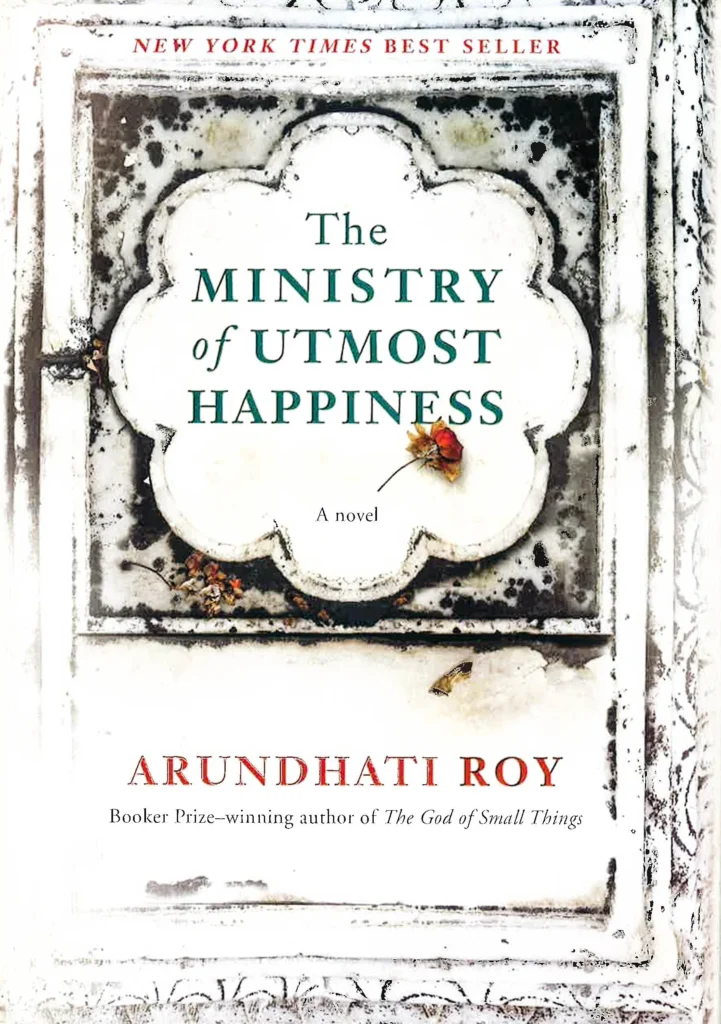
The Ministry of Utmost Happiness is a novel about the humble lives of marginalised people in Old Delhi, especially the Muslim hijras of Khwabgah. Unconventionally narrated, it may not appeal to readers who might constantly compare it with The God of Small Things, a novel deeply rooted in Roy’s lived experiences and formative years, carrying a rare emotional rawness to it. And she wrote it when she was younger. The Ministry of Utmost Happiness, on the other hand, feels shaped more by her observations as a young adult in Delhi.
The ambitious, chaotic, and deeply political novel long listed for the 2017 Man Booker Prize was praised for its lyrical power. Following two central figures, Anjum, an intersex woman living in a graveyard community, and Tilo, who becomes entangled in the Kashmir independence movement, weaves through decades of political violence, social unrest, and personal trauma. The novel’s greatest strength lies in its atmosphere and moral force. Roy writes with urgency, dark humour, and compassion, exposing state violence, religious conflict, and human suffering through unforgettable imagery. Even when the narrative becomes confusing, the novel moves forward with emotional intensity, though it certainly demands patience and attentiveness from the reader.
At the same time, the book can feel sprawling and difficult to follow. Roy shifts abruptly between timelines, narrators, and perspectives, often abandoning characters for long stretches. Dense passages of political commentary, history, and philosophical digressions can overwhelm the story, making it feel less plot-driven than thematic. For some readers, this complexity enriches the novel; for others, it makes the book emotionally distant and structurally frustrating. Ultimately, The Ministry of Utmost Happiness is less a conventional novel with a mosaic of voices, histories, and wounds — messy, challenging, and often queerly brilliant.
As a reader, I felt more deliberation and intellect at work here than in The God of Small Things or Mother Mary Comes to Me, where I felt Roy writing more directly from the heart. In Mother Mary Comes to Me, traces of many of her fictional worlds reappear, unfolding with remarkable maturity, grace, and honesty.I was surprised at myself loving the author. Reading it, I could sense both the author’s transformation and my own evolution as a reader. Another time, perhaps, on that spectacular book, added to my favourite list. Luckily, the Ministry of Utmost Happiness helped me fall out of love. The Algebra of Infinite Justice is entirely different again — not a novel, but a powerful collection of essays, distinct both in genre and style.
The Ministry of Utmost Happiness, ultimately, is a novel for readers willing to surrender to its flow.